The Neuroscience, Yogic Philosophy, and the Hidden Intelligence of the Human Hand
“The hand is the visible part of the brain.”
— Immanuel Kant
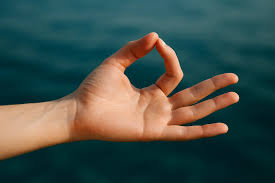
Bring your thumb and index finger together for a moment.
You did not merely form a gesture. You altered neural activity, sensory feedback, autonomic balance, and attentional state.
This is the quiet power of mudras — ancient yogic hand gestures that function as interfaces between consciousness and the nervous system.
Often dismissed as symbolic or ritualistic, mudras are, in truth, precise psycho-neuro-biological tools, refined through millennia of embodied experimentation. Modern neuroscience is only now discovering what yogis mapped long ago—using a different language, but pointing to the same reality.
What Are Mudras—Really?
In Yoga and Ayurveda, mudra means seal, gesture, or circuit.
But this definition barely scratches the surface.
Mudras are intentional configurations of the hands and fingers designed to:
- Regulate mental states
- Stabilize attention
- Balance autonomic activity
- Direct prāṇic flow
- Encode symbolic meaning into bodily action
They are not passive. They are active neural instructions.
Why the Hands? A Neuroscientist’s Answer
1. The Hand Has a Massive Cortical Footprint
Our hands and feet are rich in nerve endings. All the nerves end at our hands and feet. In the brain’s sensory and motor maps (the cortical homunculus), the hands—especially the fingers—occupy a disproportionately large area.
This means:
Small movements of the fingers create large-scale changes in brain activity.
Mudras exploit this neurological leverage.
A subtle finger configuration:
- Alters sensory input
- Modifies motor planning
- Stabilizes attention networks
- Influences thalamo-cortical rhythms
Yoga discovered this long before fMRI scanners.
2. Fingers Are Sensory Powerhouses
Each fingertip contains dense mechanoreceptors responsible for touch, pressure, and proprioception.
When fingers touch or press lightly:
- Sensory feedback loops close
- The nervous system becomes self-referential
- Attention turns inward naturally
This is closed-loop neural regulation—a principle central to cybernetics, control theory, and meditation alike.
The Yogic Cosmology of the Hand: Five Fingers, Five Elements
Yoga does not view the body merely as anatomy—it views it as a microcosm of the universe.
Each finger corresponds to a mahābhūta (fundamental element):
| Finger | Element | Yogic Meaning | Neuropsychological Parallel |
|---|---|---|---|
| Thumb | Agni (Fire) | Will, transformation | Executive function, intention |
| Index | Vāyu (Air) | Movement, thought, mind and intellect | Attention, cognitive flexibility |
| Middle | Ākāśa (Ether) | Space, integration | Global awareness, DMN regulation |
| Ring | Pṛthvī (Earth) | Stability, grounding | Body schema, proprioception |
| Little | Jala (Water) | Flow, emotion | Limbic modulation, affect |
This is not poetic mysticism.
It is symbolic compression of embodied neuroscience.
Why the Thumb Is Central in Almost Every Mudra
Nearly all mudras involve the thumb.
Neuroscience Explains Why
- Thumb opposition is uniquely human
- Strongly linked to intention and motor planning
- Deeply connected with prefrontal control circuits
Yoga Explains Why
- Thumb represents Agni (Fire)
- Fire initiates transformation
- Without fire, no change occurs
In mudras, intention (thumb) meets structure (other fingers).
Case Study: Gyan Mudra (Gesture of Knowledge)
Thumb + Index Finger
Yogic Interpretation
- Fire (Agni) + Air (Vāyu)
- Stabilizes knowledge
- Calms the fluctuations of the mind
- Deepens meditation
Neuroscientific Interpretation
- Enhances sustained attention
- Reduces mind-wandering
- Balances frontal–parietal networks
- Promotes alpha brain rhythms (calm alertness)
Translation:
Gyan Mudra creates a stable attentional loop—alert but not agitated.
This is why sages across cultures independently converge on this gesture.
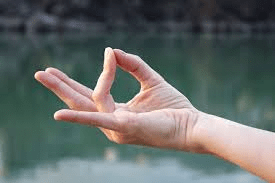
Orientation Matters: Chin Mudra vs. Gyan Mudra
Same fingers.
Different palm orientation.
- Gyan Mudra (palms up): receptivity, openness
- Chin Mudra (palms down): grounding, embodiment
Neuroscience calls this contextual motor framing.
Yoga calls it direction of prāṇa.
Same mechanism. Different vocabulary.
Mudras and the Autonomic Nervous System
Mudras influence more than cognition—they regulate physiology.
Gentle finger pressure and sustained posture can:
- Stimulate the vagus nerve
- Reduce sympathetic overdrive
- Increase parasympathetic tone
- Improve heart rate variability
This explains why mudras:
- Reduce anxiety
- Improve emotional regulation
- Support restorative states
They are micro-interventions for nervous system balance.
Mudras as Embodied Symbols
Here lies the deepest insight.
The brain does not separate:
- Action
- Meaning
- Emotion
When you hold a mudra:
- You enact a symbolic state
- The body embodies meaning
- Consciousness reorganizes accordingly
This is embodied cognition—a cornerstone of modern neuroscience, discovered experientially by yogis.
Why Mudras Feel Subtle Yet Profound
Mudras do not overwhelm the nervous system.
They:
- Work beneath conscious effort
- Avoid sensory overload
- Create slow neural entrainment
Yoga understood a timeless truth:
Lasting transformation is quiet.
Mudras whisper to the nervous system—and the nervous system listens.
The Forgotten Truth
Mudras are not decorative gestures.
They are interfaces between:
- Body and mind
- Intention and physiology
- Symbol and synapse
- Cosmos and cortex
When a yogi joins two fingers, they are not performing ritual.
They are rewiring awareness.
Closing Reflection
Your hands are not merely tools for interacting with the world.
They are:
- Extensions of the brain
- Antennae of consciousness
- Instruments of inner technology
Every mudra asks the nervous system a quiet question:
Can you be still?
Can you be balanced?
Can you remember who you are?
And astonishingly—
the nervous system answers.
